AFIR 2027: What Must EV Charging Station Operators Comply With?
From 1 January 2027, all publicly accessible fast charging stations with a power output of 50 kW or more along major European transport routes must accept card payments – even if they were installed years ago. This is one of the most significant impacts of the European Alternative Fuels Infrastructure Regulation (AFIR), which introduces requirements for charge point operators (CPOs) covering payments, pricing, charging capacity and data sharing. What exactly do these requirements involve, which deadlines must operators meet, and how should they prepare?
What Is AFIR and Who Does It Apply To?
AFIR (Alternative Fuels Infrastructure Regulation) is EU Regulation 2023/1804, which governs the deployment of alternative fuels infrastructure. It has been directly applicable in all EU Member States since April 2024, with its requirements being introduced progressively.
AFIR establishes requirements for ad-hoc payments, price transparency, available charging power, data sharing and support for selected technical standards.
A new wave of requirements takes effect on 1 January 2027, including payment terminals at existing fast charging stations, mandatory support for ISO 15118-20 at new charging points, and increased charging capacity targets along major transport routes.
What Payment Methods Must EV Charging Stations Support Under AFIR?
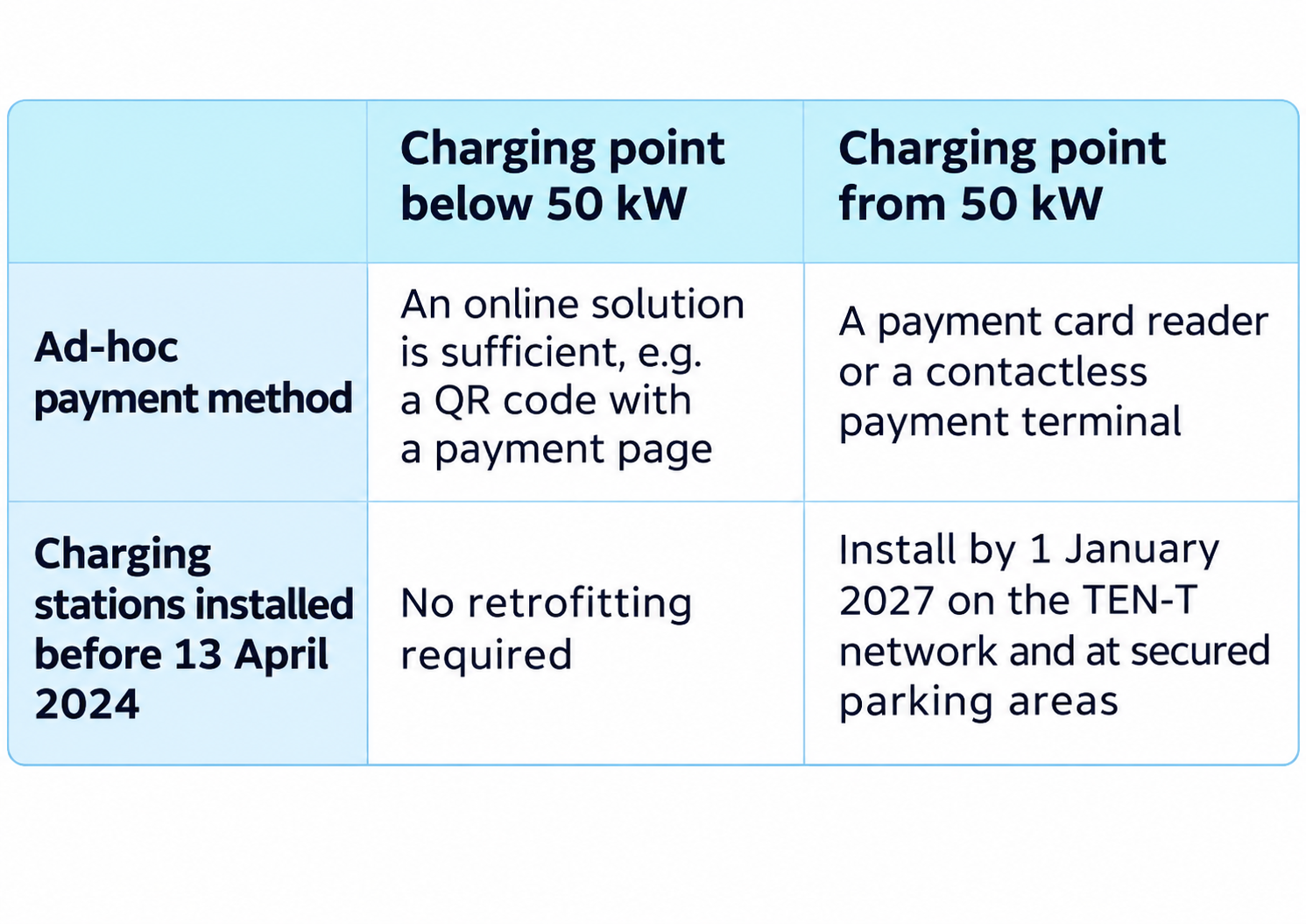
Drivers must be able to charge and pay on an ad-hoc basis, without downloading an app, registering or entering into a contract. The required payment method depends on the power output of the charging point.
Which Existing Fast Charging Stations Must Have Payment Terminals by 2027?
The requirement to retrofit payment terminals also applies to existing fast charging stations with a power output of 50 kW or more if they are located along the Trans-European Transport Network (TEN-T) – which includes most major motorways and transport corridors – or at safe and secure parking areas.
How Must EV Charging Station Operators Display Prices?
Ad-hoc charging prices must be reasonable, non-discriminatory and easy to compare. The requirements for pricing and price display vary depending on the power output of the charging point.
Charging Points of 50 kW or More
Electricity must be billed based on energy consumption in kWh. Operators may also charge an occupancy fee if a vehicle remains parked after charging has finished.
Prices must be displayed directly at the charging station. For stations without a display, a permanent price label (ZfK) is sufficient.
Charging Points Below 50 kW
Pricing information may be made available through an app or website, for example. However, the individual price components must be presented in the prescribed order:
- Price per kWh.
- Price per minute.
- Price per charging session.
- Other fees.
What Minimum Charging Power Does AFIR Require Along the TEN-T Network?
AFIR establishes minimum requirements for the power capacity and distribution of charging pools along major European transport corridors.
For passenger cars, AFIR requires a charging pool every 60 km in each direction of travel along the TEN-T core network.
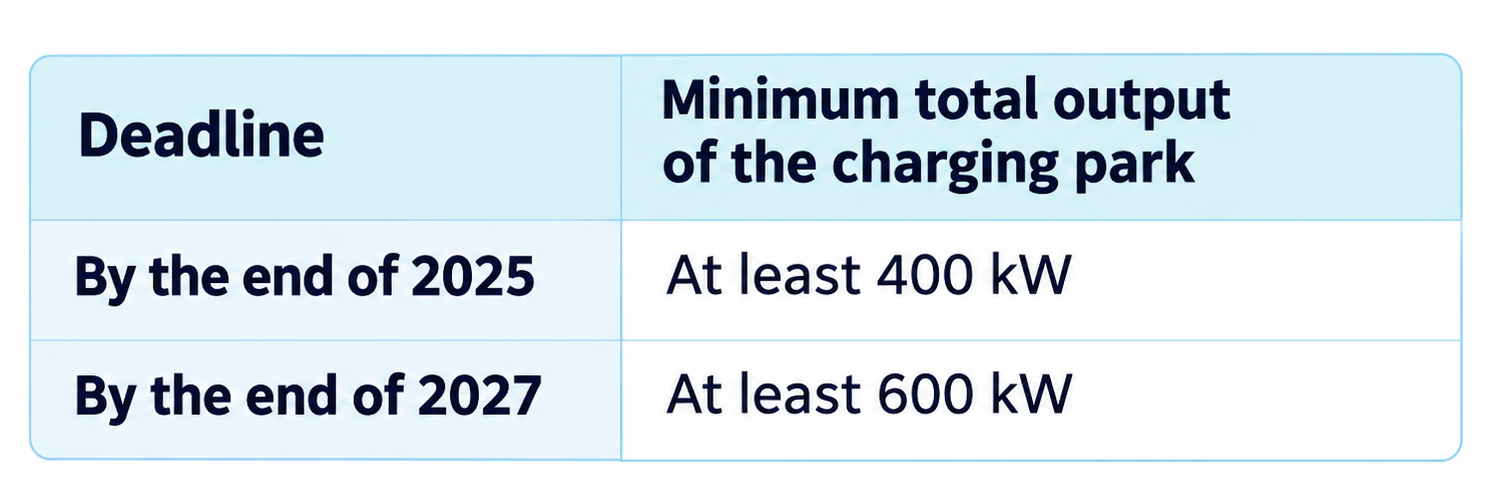
Each charging pool must include at least one charging point with a power output of 150 kW.
For heavy-duty vehicles, separate charging pools with charging points rated at 350 kW or more are planned.
EU Member States are responsible for meeting these targets and incorporating the requirements into funding programmes and spatial planning. For investors, this translates into growing demand for high-power charging locations.
What Data Must EV Charging Station Operators Share Under AFIR?
Since 14 April 2025, operators have been required to make static and dynamic data on publicly accessible charging points available free of charge.
The required information includes:
- Charging point location.
- Operational status and real-time availability.
- Ad-hoc charging price.
- Information on the renewable origin of electricity.
Data is shared through a National Access Point (NAP). Operators’ backend systems must therefore be capable of generating and providing the required information.
What Changes Does AFIR 2027 Introduce Regarding ISO 15118?
Implementing regulations under AFIR introduce mandatory support for the ISO 15118 communication standard for newly installed or renovated charging points.
The requirements are being introduced in stages:

These requirements apply to newly installed or renovated charging points.
What Does AFIR 2027 Mean for EV Charging Station Operators?
Compliance with AFIR is not simply a matter of installing a payment terminal. The terminal must be integrated with the backend system, pricing mechanisms and accounting processes.
Ad-hoc payments currently account for only a small proportion of charging sessions – approximately 4.4% in Germany. When choosing a technology solution, operators should therefore consider not only the initial investment but, more importantly, the long-term operating costs.
What Should Operators Do Before 2027?
- Map the charging network: Identify which fast charging stations are located along the TEN-T network or at safe and secure parking areas.
- Assess payment terminals: Check whether existing stations can be retrofitted and compare the associated costs with replacing the charging stations.
- Review price displays: Verify that the price per kWh is correctly displayed directly at the charging station.
- Check backend capabilities: Ensure that data can be shared in the format required by AFIR.
How Can Polyfazer Help You Prepare for AFIR?
We can help you assess your existing charging network, evaluate its compliance with AFIR requirements and identify the most cost-effective approach to meeting the new obligations.
Together, we will develop a technical solution that addresses payment terminal requirements, pricing, backend integration and other regulatory changes taking effect in 2027.
Need to prepare your charging network for AFIR 2027? Contact us to arrange a free, no-obligation consultation 👉 sales@polyfazer.cz
This article is based on legislation and publicly available sources as of 8 October 2026. It does not constitute legal advice.